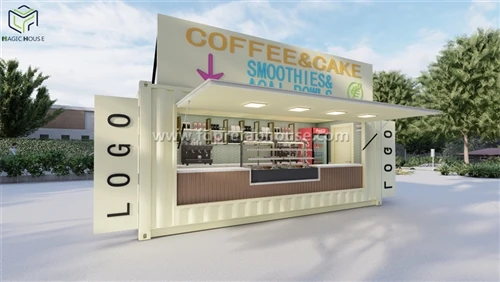
In the first half of 2026, a batch of 20ft container cafés shipped from China to the Port of Le Havre, France, completed customs clearance and was delivered to the customer. One common feature of these units was that all interior walls were covered with 304 stainless steel, with polished welds and a design intended to minimize hard-to-clean areas. This was not simply a voluntary upgrade by the manufacturer, but was driven by food hygiene and compliance requirements associated with the European market.
How DDPP Inspections Are Affecting Container Cafés
Within the EU regulatory framework, mobile food units are subject to food hygiene requirements covering areas such as food-contact surfaces, cleaning, and hygienic operation. When the French Departmental Directorate for the Protection of Populations (DDPP) inspects converted container-based food premises, key considerations can include whether interior surfaces are easy to clean, whether difficult-to-clean areas exist, and whether joints between equipment and walls are properly sealed.
304 stainless steel is widely used for food-service interiors because it offers corrosion resistance, a smooth surface that can be cleaned and disinfected, and the ability to finish welded joints through grinding and polishing. According to industry observations, containers exported to Europe were previously used primarily for storage-related applications. As more containers have been converted for food-service operations, European customers have increasingly specified requirements such as "fully stainless-steel interiors" during the quotation and design stages. What was once an individual customer preference is therefore becoming an important technical consideration for container-based food-service projects in the European market.
How Compliance Requirements Affect Manufacturing
This shift has had a practical impact on the manufacturing process for container conversions. Stainless-steel interior panels need to be installed after the wall insulation system has been completed, while panel cutting requires greater dimensional accuracy than conventional decorative wall finishes. Welded joints also require dedicated grinding and polishing processes.
Stainless-steel protection around cooking areas, including the space around cooktops, range-hood grease collection areas, and fryer worktops, also needs to be incorporated into the factory prefabrication process. For exporters serving the European market, this means that a food-service-grade interior can no longer be treated simply as an optional decorative upgrade. It needs to be considered as part of the overall manufacturing and hygiene-control process.
Industry analysis suggests that these requirements are encouraging container-conversion manufacturers to move beyond basic refurbishment toward more specialized fabrication for food-service applications.
Parallel Requirements in the UK Market
Although the UK is no longer part of the European Union, food hygiene, fire safety, building control, and electrical requirements remain important considerations when a shipping container is converted into a food-service premises.
Depending on the project location and intended use, planning permission or other local approvals may be required. Typical structural and installation work includes cutting and reinforcing steel frames around doors and windows, installing interior insulation and moisture-control layers, fitting consumer units and lighting outlets, providing wastewater drainage and hot-water supply, and installing extraction systems for cooking equipment.
Much of this work can be completed at the factory before delivery. On site, the remaining work can then focus primarily on positioning the unit and connecting external utilities and services.