1. Overview
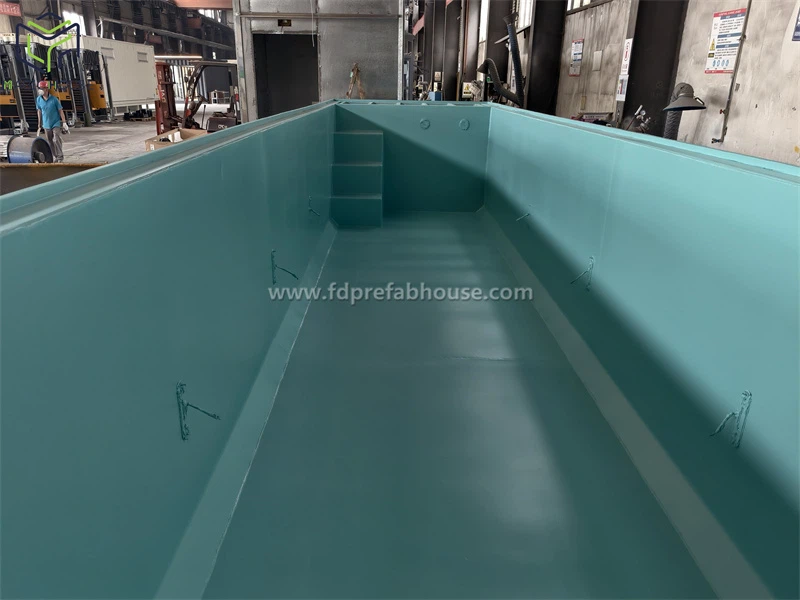
Spray painting (coating) of the pool inner liner is a critical step for waterproofing and corrosion protection. It directly affects the service life of the pool body and water quality safety. The inner coating must have excellent water resistance, chemical resistance (especially to chloride ion attack), and good adhesion to the substrate.
2. Pre‑construction Preparation
Surface preparation: The substrate must be thoroughly cleaned before painting. Remove dust, grease, cement laitance, and other contaminants. Defects such as pitting, honeycombing, holes, and cracks shall be repaired and smoothed. For renovation projects, all old lining coatings must be completely removed.
Environmental conditions: Ambient temperature during construction should be 0–35 °C, substrate moisture content ≤5%, and relative humidity below 75%. Avoid construction when temperatures are below 0 °C or above 40 °C.
Material preparation: Inner liner coatings are typically two‑component (base + curing agent). They must be mixed in the specified ratio, thoroughly stirred, and allowed to stand for 5–10 minutes before application. For example, epoxy waterproof paint is usually mixed at a weight ratio of 5:1 (Part A : Part B).
3. Spray Painting (Coating) Procedure
Primer application: The primer must be compatible with the topcoat to ensure system stability and durability. Before priming, the substrate must be clean and dry. The primer is applied evenly with a roller, brush, or spray gun, ensuring uniform coverage without misses or runs. Allow the primer to dry completely, typically 2–4 hours. The primer dry film thickness should be controlled at 50–100 μm.
Topcoat application: The topcoat should be a specialised swimming‑pool coating with good water resistance, chemical resistance, and abrasion resistance. Clean the primed surface before topcoating. Apply the topcoat in 2–3 passes using a spray gun or roller, allowing each coat to dry completely before the next. The total topcoat thickness should reach 150–200 μm. The interval between coats is usually 12–24 hours.
Treatment of key areas: Inlets, outlets, internal corners, and other critical locations should be brush‑painted first with a bristle brush before the main area is coated.
Curing: After all coats are applied, the liner must be cured. During curing, protect the coating from direct sunlight, rain, and mechanical damage. The curing period is generally 7–14 days, depending on ambient temperature and humidity. Only after curing is complete may the pool be filled with water.
4. Quality Inspection
After coating completion, quality checks must be performed, including film thickness measurement (using a coating thickness gauge), adhesion test (cross‑cut test), and water resistance and chemical resistance tests (immersion test). Results must meet design specifications and applicable standards.