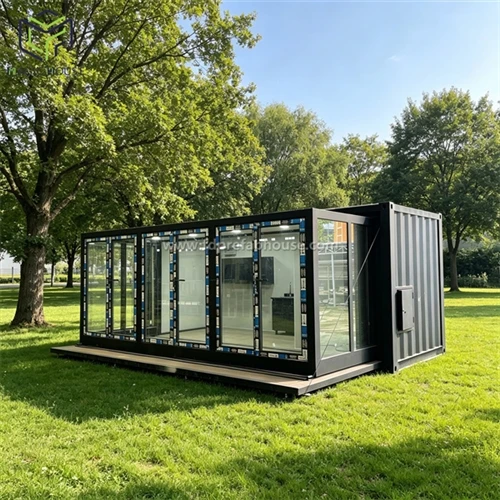
If a container café is to be placed near the sea – for example, along the Florida coast, California Highway 1, Hawaii, or the Caribbean – the biggest challenge is not wind or waves, but invisible salt‑spray corrosion. Chloride ions in sea breezes quickly penetrate ordinary paint layers, causing red rust within 1‑2 years and potential structural failure within 3‑5 years. Many first‑time clients underestimate this, leading to expensive repairs or even scrapping the unit.
Industry‑Proven Solutions
Base material selection
Prefer hot‑dip galvanized steel (double‑side zinc coating ≥275 g/㎡)
Or Corten A/B weathering steel (forms a dense oxide layer that inhibits further corrosion)
Coating system
Recommended: Epoxy zinc‑rich primer (zinc content ≥80%) + epoxy micaceous iron oxide intermediate + aliphatic polyurethane topcoat
Total dry film thickness ≥240 μm; critical areas (welds, cut edges, bolted connections) should be increased to ≥300 μm
Process requirements
All welds must be ground smooth and given secondary anti‑corrosion treatment (e.g., cold‑galvanizing spray or epoxy repair paint)
Leave a ventilation gap or install rubber pads at the bottom where the container contacts the ground to avoid water pooling
Testing & certification
Provide ASTM B117 salt spray test report, requiring ≥500 hours without red rust (≥1000 hours is recommended for coastal projects)
For the US market, ASTM D5894 (cyclic salt spray/UV test) is also common, more closely simulating real coastal conditions