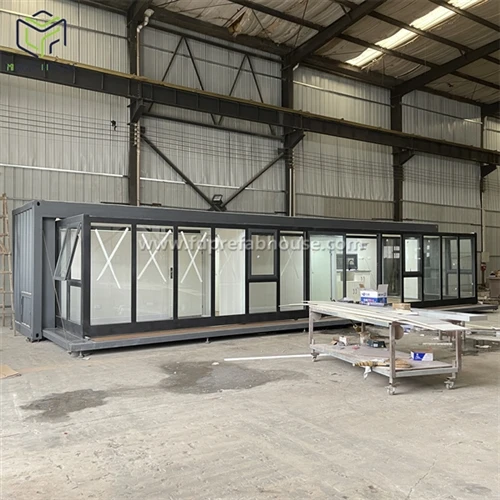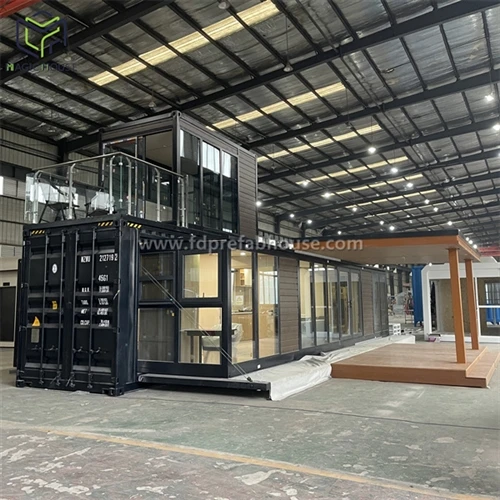
During the design and manufacturing phases, 40-foot container homes must adhere to strict dimensional limits: external dimensions must not exceed 11.8m (length) × 2.2m (width) × 2.5m (height).
This dimensional limit is not arbitrary; it is dictated by the transport dimensions of standard shipping containers. While a standard 40-foot High Cube container has internal dimensions of approximately 12.03m × 2.35m × 2.69m, the actual usable loading space is restricted by factors such as the container door frame dimensions and internal structural protrusions.
For expandable container homes, controlling dimensions during transport is particularly critical. These units are transported in a "folded" state, with extendable sections retracted inward to match the width of a standard shipping container. If the finished unit's dimensions exceed the standard container's loading envelope, it cannot be loaded into a container for ocean freight.
Industry data indicates that an expandable 40-foot container unit can provide an internal area of approximately 70 to 80 square meters (approx. 750 to 860 square feet) once fully expanded. This space is sufficient to accommodate three bedrooms, two bathrooms, and functional areas such as a living room, dining room, and kitchen.
In actual production, dimensional control must be maintained throughout the design, manufacturing, and quality inspection processes:
Design Phase: Account for the thickness of insulation layers, exterior wall panels, and door/window frames.
Production Phase: Fabricate strictly according to blueprints to prevent cumulative errors.
Quality Inspection Phase: Measure actual dimensions prior to shipment to ensure compliance with limits.