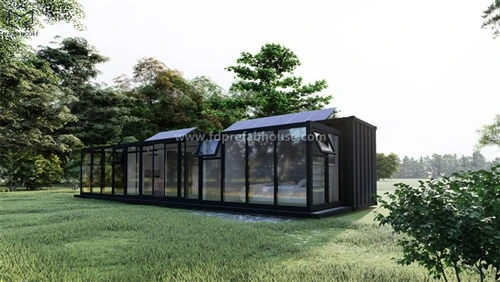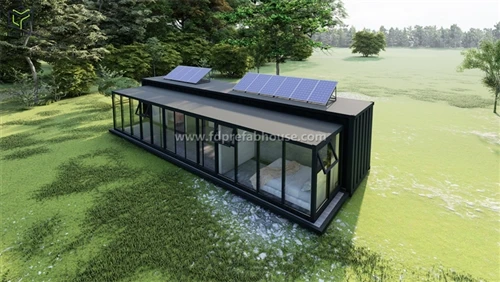
One of the core advantages of container buildings is green sustainability – repurposing discarded cargo containers into functional spaces is a best practice of the circular economy. With the rapid development of new materials, photovoltaic storage, and smart control technologies, container buildings are evolving from simple "steel boxes" into green, intelligent, and efficient spatial solutions.
1. Material Innovation: From Steel Box to Tech Module
Material upgrades have dramatically improved product quality and service life. In 2024, China's total container production exceeded 8.1 million TEUs, up 268.2% year‑on‑year, accounting for 96% of global production. Key breakthroughs include:
Zn‑Al‑Mg coated low‑alloy structural steel – Ultra‑high corrosion resistance and self‑healing properties, suitable for high‑salt coastal areas.
Ceramic fiber "armour" – Greatly improves fire resistance.
Water‑based paints – Replace solvent‑based paints, significantly reducing VOC emissions.
Bamboo flooring – Replaces traditional wood flooring, reducing forest resource consumption.
Bio‑based composites – Made from agricultural waste such as corn stalks; density less than 1/4 of steel, tensile strength 2‑3 times that of metal.
Fangda Magic House follows these material trends, focusing on recyclability and environmental responsibility.
2. Photovoltaic Systems: Self‑Sufficient Energy for Container Buildings
The combination of PV technology and container buildings is gaining momentum.
Example 1 – Containerised PV + storage system – PV modules, batteries, charging modules, and energy management are integrated into one container. The system can be quickly transported, lifted into place, and put into service; deployment efficiency is 80% higher than traditional methods.
Example 2 – High‑efficiency PV + storage – Using monocrystalline silicon modules (efficiency up to 23.2%) and Li‑FePO₄ batteries (cycle life >6000 times) to form a smart microgrid. An intelligent energy management hub monitors PV output, battery status, and load in real time, enabling day‑time self‑generation and night‑time battery discharge. Annual generation can exceed 93,600 kWh, meeting the electricity needs of 80‑120 people, saving over RMB 100,000 in electricity costs per year, and reducing CO₂ emissions by about 80 tons.
Fangda Magic House's advantage – All our product lines (coffee shops, swimming pools, houses) can be optionally equipped with PV systems. From basic rooftop panels to integrated BIPV glass solutions, everything can be prefabricated and ready for immediate use.
3. Smart Control Systems: From Passive Space to Active Perception
Smart controls enable container buildings to actively sense and automatically adjust, greatly improving user experience and energy efficiency.
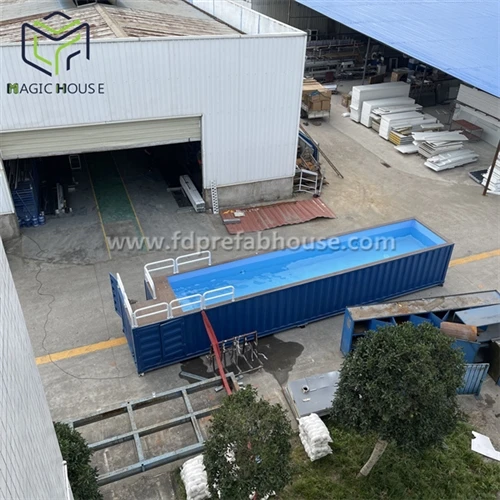
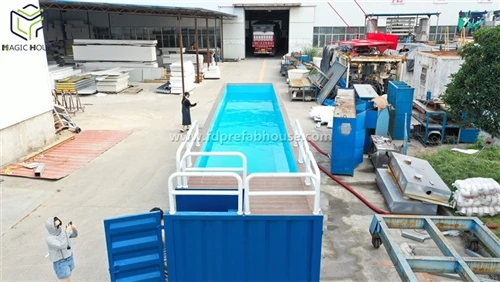
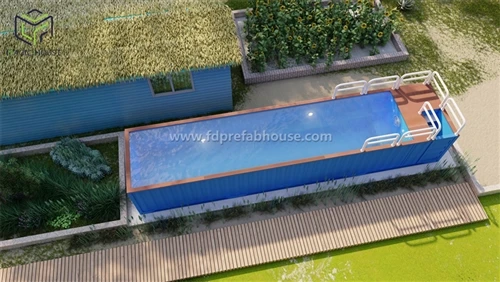
IoT sensors – For container swimming pools, water quality sensors monitor temperature, pH, chlorine, and equipment status, sending alarms in case of anomalies.
Remote energy management – Users can control A/C, lighting, blinds, and PV storage via a mobile app, optimising energy use even in unattended scenarios.
Smart microgrid dispatching – Automatically switches between PV, battery, and grid power based on real‑time electricity prices and load, enabling peak shaving and long‑term cost savings.
Fangda Magic House's philosophy – "Create smart spaces, be a tech pioneer" – is embodied in the systematic integration of IoT, remote control, and smart energy management. Whether for a coffee shop, a swimming pool, or a house, our products become a thinking, responsive "smart space".