When planning sanitary facilities for construction sites, large events, temporary camps, or municipal projects, you typically face four key decisions: How many toilet units do I need? Which waste disposal system suits my site? What dimensions and layout work best? Can the product be customized?
As a professional manufacturer with over 15 years of export experience, we help customers across the U.S., Europe, Australia, and the Middle East solve these challenges every day. Below is our clear guidance based on international codes and real project know‑how.
|
|
|


1. Toilet Count – Precisely Calculated to International Standards
Your concern: Too few units – non‑compliant and inadequate; too many – wasted budget.
Our approach: We never guess. We strictly follow the latest building and plumbing codes of your project's country.
U.S. market: We apply the IPC (International Plumbing Code) – calculating the minimum number of water closets and urinals based on building type (office, retail, assembly, etc.) and design occupancy, with gender allocation (typically 50/50).
UK & Commonwealth: We reference BS 6465 or the HSE workplace guide – e.g., 1 unit for 1‑5 people, 2 units for 6‑25, and so on.
Mainland Europe: Our products comply with EN 16194, which specifies minimum quantities and maximum service loads for non‑sewer‑connected mobile toilets under different usage intensities.
Accessibility: We ensure compliance with ADA (Americans with Disabilities Act) or equivalent local regulations – e.g., at least 1 accessible unit per 6 total units, with proper clearances and fixtures.
Our service: Simply provide the project type, estimated headcount, and site layout, and we will issue a compliant and cost‑effective toilet configuration plan that helps you pass local inspections smoothly.
|
|
|
|


2. Waste Disposal – Four Proven Options Tailored to Your Site
Does your site have sewer access? How long is the project? What are local environmental regulations? We match the most suitable system for you:
| System | Best For | Our Advantages |
|---|---|---|
| Chemical Toilet (holding tank + chemicals) | Short‑term sites, outdoor events, areas without water/power | Ready to use, no external connections, easy maintenance, lowest cost |
| Self‑Contained Holding Tank (with flush toilet) | Medium‑term projects (3‑12 months) | Higher comfort, can include washbasins; regular pumping by licensed contractors |
| Vacuum Sewage System (90% water saving) | Large‑scale/long‑term sites, premium events, multi‑storey buildings | Odour‑free, leak‑proof, flexible piping, long‑term benefit with higher initial investment |
| Composting / Dry Toilet | Nature reserves, environmentally sensitive areas | Zero water consumption, zero chemicals, meets strictest ecological standards |
Our recommendation: We evaluate your project duration, on‑site utilities, and local regulations to propose the most cost‑effective solution. For example, U.S. job sites commonly use chemical toilets with regular servicing, while major European infrastructure projects often prefer vacuum systems.
3. Dimensions & Layout – Standardised + Modular for Maximum Flexibility
Every project site is unique. Our products combine standard sizes with modular combinations to fit any space.
Standard single‑unit dimensions:
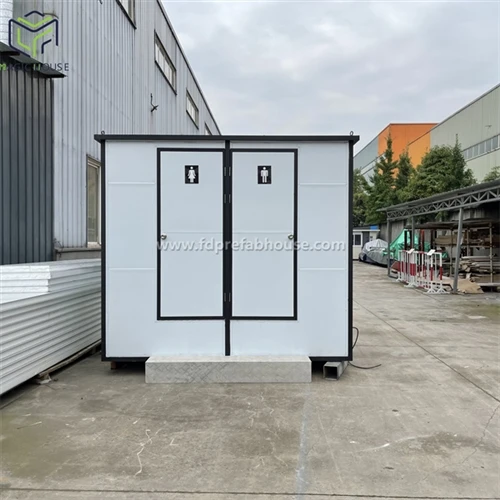
Standard single: 1300×1100×2400 mm (H)
Accessible: 1500×1400×2400 mm or larger (ADA‑compliant)
Compact: 1100×1100×2300 mm (for tight spaces)
Popular container‑type (export favourite):
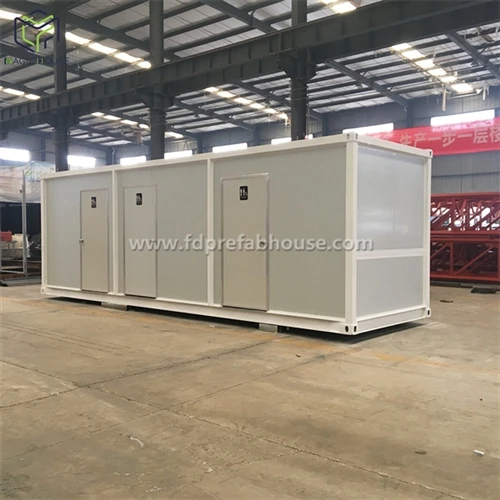
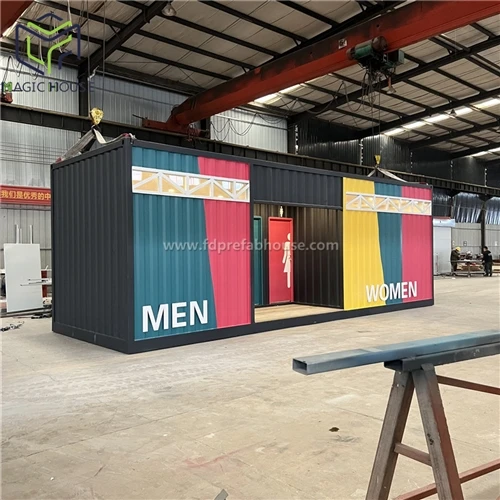
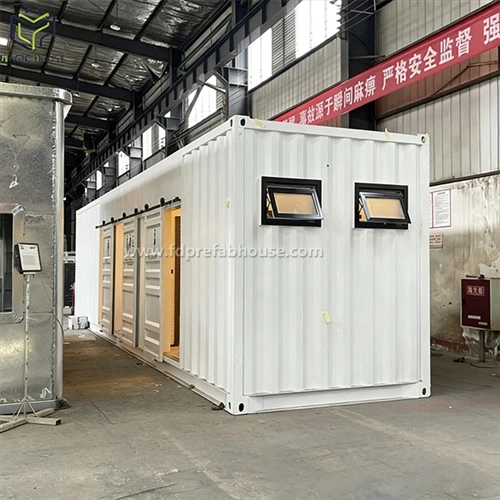
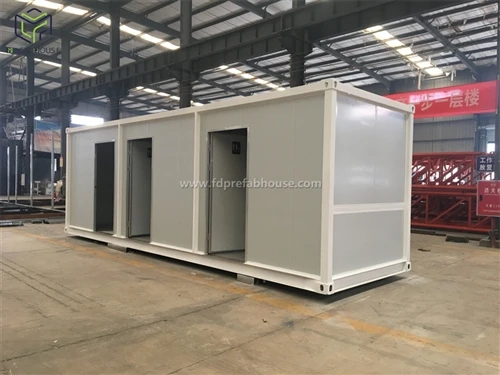
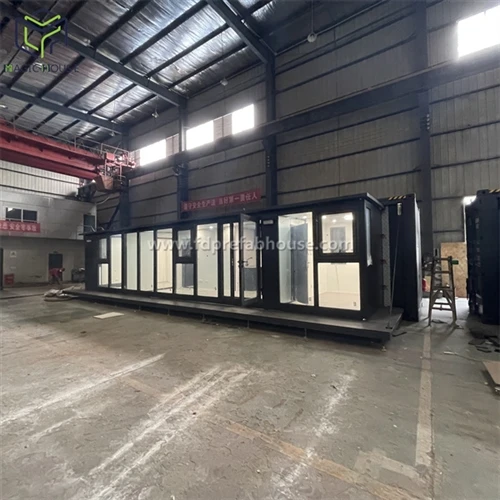
Based on the 20‑ft container footprint (approx. 6×2.4×2.6 m), with flexible internal layouts:
Option A: 6 water‑closet stalls + 1 urinal room (6 urinals)
Option B: 3 WCs + 6 urinals + 4 washbasins
Option C: Custom arrangement as per your needs
Precise electrical configuration:
We supply the correct voltage for your destination – 110V/60Hz for U.S./Canada, 240V/50Hz for UK/Europe, 230V/50Hz for Australia – eliminating the need for converters.
Climate‑adaptive design:
For cold regions, we add insulated sandwich panels (50/75/100 mm) and freeze‑proof piping. For hot climates, we can install ventilation fans or air conditioning.