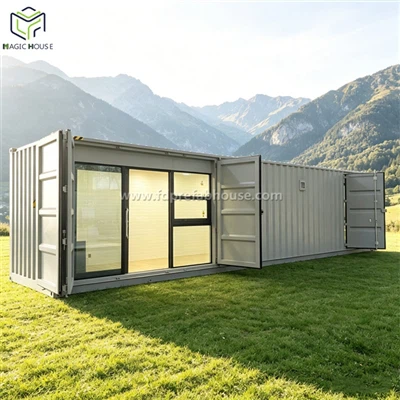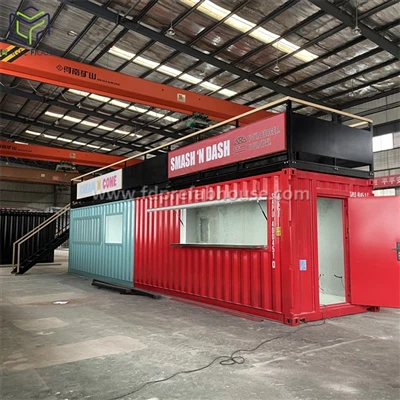
When Catherine Payne's $130,000 micro-housing in Western Australia became a "storage room" in her father's front yard, this predicament, stemming from policy ambiguity and standards disputes, not only exposed the deep-seated contradictions in the Australian micro-housing market but also illuminated the path forward for Chengdu-based Fangda Magic House. As a service provider with 14 years of experience in the mobile space sector and operations in over 30 countries worldwide, Fangda Magic House, with its mature export system and precise customization capabilities, stands at the intersection of opportunities and challenges in the Australian market. Its path to breakthrough is not only crucial for the company's development but also holds the potential to provide a new solution to Australia's housing crisis.

Opportunity: A Perfect Match of Strengths Amidst Pain Points, A Blue Ocean Market Under Policy Opportunities
The chaos and unmet demand in the Australian micro-housing market perfectly align with Fangda Magic House's core strengths. From policy pilot programs to the explosion of diverse demands, the company's export experience and customization capabilities are now poised for optimal monetization.
Opportunities for Compliance Solutions Amidst the Policy Maze
The core of the Payne family's tragedy lies in the classification controversy surrounding "wheeled houses being classified as attached dwellings," a problem prevalent in Australia. Griffith University Professor Paul Burton points out that national micro-housing policies are characterized by "high differentiation, complexity, and confusion." This pain point is precisely where Fangda Magic House's strength lies: leveraging its experience in customizing mobile buildings for clients in New Zealand, Switzerland, and other countries, the company has already established a design system of "standard adaptation + clear classification." Addressing the policy differences among Australian state parliaments, it can utilize modular technology to design products with dual attributes: complying with the requirements for wheeled vehicles under the Road Traffic Act 2013, possessing a clear vehicle identification number to meet Western Australia's "two-year camping" requirement; and through structural adjustments, adapting to the "no development application required" permanent residential conditions in the Shellharbour Parliament pilot program in New South Wales. This "one house, two regulations" customization capability effectively avoids compliance risks like those faced by Payne, and Fangda Magic House's existing experience with extendable container homestay projects in Australia further solidifies the feasibility of this solution.
|
|
|
|
|
|


Opportunities for Differentiated Supply Amid Explosive Demand
The Australian micro-housing market is experiencing a surge in demand: Queensland's rental demand now encompasses diverse groups, including young people and seniors, with 4-meter-long micro-homes fetching weekly rents of AU$149 and easily convertible into commercial spaces like hair salons; New South Wales' pilot program explicitly positions micro-homes as a "low-cost housing option" to alleviate the housing crisis. Fangda Magic House's customization advantages shine in this context: for seniors, they can replicate the "ready-to-move-in" extended container experience created for New Zealand clients, integrating medical call interfaces and barrier-free design to meet nearby healthcare needs; for the rental market, they can offer standardized 4-6 meter products with customized features such as air conditioning and solar panels, aligning with Australian consumers' pursuit of sustainable living; for special scenarios like mining camps and emergency shelters, their container-converted impact-resistant structures are adaptable to the needs of large-scale development in northern Australia and natural disaster response. This "scenario-based customization" capability is far more competitive than the standardized products of local Australian companies like Aussie Tiny Houses.
|
|
|
|
|
|


Challenges: The Dual Test of Standard Barriers and Market Differences
Behind the opportunities, the rigid barriers and cultural differences of the Australian market also pose serious challenges to Fangda Mofang's ability to transform its advantages. From stringent technical standards to a complex local ecosystem, the company needs to complete a profound leap from "product export" to "value realization."
Rigid Technical Standards and Adaptation Costs
Australia's requirements for building products are almost stringent, far exceeding the standards for ordinary exports. Firstly, there are certification barriers across the entire supply chain: all building materials must pass NATA certification testing, and asbestos-free certification is an insurmountable red line. A Chinese company once had its goods destroyed and was blacklisted because its boards contained 0.1% asbestos. Although Fangda Magic House uses Australian standard water and electricity systems in its New Zealand project, it still needs further customization and upgrades to meet the specific requirements of different regions in Australia-such as Queensland's tropical cyclone rating for withstanding 170 km/h winds and the fire safety standards of the southern region. Secondly, there are hidden costs associated with renovations: the Payne family home, designed as a motorhome, requires a huge investment to convert into a permanent residence. This warns Fangda Magic House that it needs to find a precise balance between "mobility" and "permanence" to avoid design deviations that could lead to renovation difficulties for clients, which would undoubtedly increase the cost pressure on R&D and production.
|
|
|
|
|
|


Operational Challenges of Fragmented Policies and Local Relationships
Australia's "one city, one policy" regulatory environment places extremely high demands on Fangda Magic House's operational capabilities. Shellharbour Council allows the installation of mobile cabins on residential land without development permits, but Wannaru Council in Western Australia imposes strict restrictions on placing houses in front yards. This difference means that companies cannot rely on a "one-size-fits-all" export model and need to establish dedicated policy tracking teams to update the "friendly council lists" and restrictions of each state in real time. Even more challenging are the compliance risks arising from neighborly relations: the Payne family's predicament stemmed directly from neighbor complaints, and the Australian parliament's enforcement principle of "maintaining community safety and residents' rights" requires products to not only meet technical standards but also consider factors such as appearance, noise, and land use to ensure community acceptance. For Fangda Magic House, accustomed to standardized production, this means adding a "community-adapted" customization dimension, which requires localized market insights as support.
The Challenges of Local Competition and Brand Recognition
The Australian micro-housing market has formed a local competitive landscape. Companies such as Aussie Tiny Houses and Baa House have secured a certain market share due to their geographical advantages, and some have begun to venture into the customization field. As a foreign brand, Fangda Mofang faced the initial challenge of a "perception gap": how to convince Australian consumers that mobile homes from China could meet local standards and adapt to their lifestyles? How to highlight the cost advantages and customization precision of "Made in China" in competition with local companies? These problems cannot be solved by product strength alone; they require long-term local operation and brand building, which will undoubtedly lengthen the return on investment cycle.
|
|
|
|
|
|


The Solution: Strengthening the Foundation with Advantages, Breaking Down Barriers with Localization
Faced with opportunities and challenges, Fangda Mofang's key to breaking through lies in deeply integrating its export experience and customization capabilities into the Australian local ecosystem. Through "compliance first, service localization, and brand scenario-based approach," it aims to transform from a "product supplier" to a "solution service provider."
In terms of compliance, a "full-chain control system based on Australian standards" should be established: Collaborating with NATA-accredited organizations such as SGS Australia, asbestos-free testing and structural testing should be conducted from raw material procurement onwards to ensure that every batch of products carries complete certification documentation. For regional standard differences, a product model of "basic modules + regional customization packages" should be developed-basic modules meet nationally unified building codes, while windproof components are added for Queensland and fire-resistant panels are upgraded for southern regions, controlling costs while ensuring compliance.
In terms of market expansion, leveraging pilot policies to create benchmark cases is a shortcut. Prioritize entry into policy-friendly regions such as Shellharbour, and collaborate with local councils to launch demonstration projects such as "wellness micro-houses" and "youth rental housing," combining the "space doubling" extension box technology customized for New Zealand customers with Australian needs to visually demonstrate the product's compliance and practicality. Simultaneously, leveraging the advantages of the Qingbaijiang Free Trade Zone, partnerships should be established with local Australian RV dealers and construction companies, with local partners responsible for council communication, installation, and after-sales services, solving cross-border response challenges.
In terms of brand building, the "Payne dilemma" needs to be transformed into a brand narrative. By participating in the Australian Microhomes Association's activities and sharing experiences on "how Chinese solutions can mitigate compliance risks," and producing customer case documentaries showcasing how products help Australian families achieve their dreams of safe living, this brand positioning of "solving local pain points" earns trust far more effectively than simple advertising.
The Payne family's "shattered dream" and Fangda Mofang's "pursuit of the dream" together paint a complex picture of the Australian microhome market. For Fangda Mofang, while the challenges in the Australian market are severe, as long as they can transform export experience into compliance guarantees and customization capabilities into demand solutions, they can not only secure a place in this blue ocean market but also inject order and hope into the chaotic Australian housing market with the power of "Made in China." This cross-oceanic endeavor will ultimately prove that true advantage is never about avoiding challenges, but about creating value by solving problems.