

Video Showcase

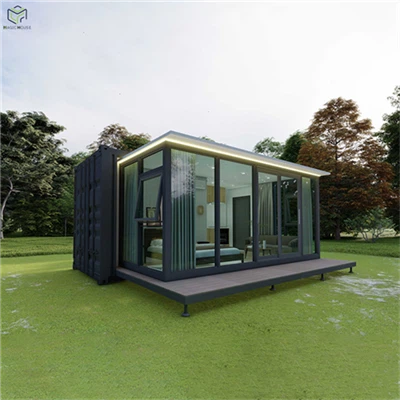
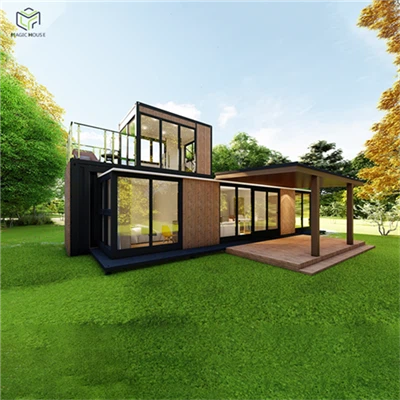
This product is a 40HQ (40-foot high cube) shipping container converted into an expandable container house for export to New Zealand. It adopts a "drawer-type" telescopic mechanical structure. After hydraulic system modification, the usable area can be expanded to twice the original size, achieving the core function of "small-volume transport, large-space living".
RAL 9005 Jet Black is a high-opacity pure black tone with stable gloss (approx. 30–40 GU at 60°), weather resistance rating of over 500 hours of salt spray resistance. WPC (Wood-Plastic Composite) grille is made of recycled wood fibre + high-density polyethylene (HDPE) with the following material properties

01
Water absorption ≤ 0.5% (24h immersion), far lower than traditional wood, ensuring dimensional stability in New Zealand's humid climate
02
Flexural strength ≥ 30 MPa, flexural modulus ≥ 3000 MPa
03
UV resistance grade 4–5 (ISO 105-B02), colour difference ΔE ≤ 2.0 for teak colour (after 300h QUV accelerated ageing)
04
Fire rating reaches B1 (difficult to ignite), thermal conductivity approx. 0.22 W/(m·K), providing some thermal insulation

Flooring System (except toilet): Stone Plastic Composite (SPC) Flooring M-17
SPC flooring is made of PVC resin + calcium carbonate, forming a high-density stone-powder composite with a wear layer. Key parameters for M-17:
- Thickness: 5.0 mm (including 1.0 mm IXPE acoustic pad)
- Wear layer thickness: ≥ 0.3 mm (Class T, EN 13329)
- Impact resistance: Indentation diameter ≤ 20 mm (EN 13329)
- Residual indentation: ≤ 0.10 mm (EN 13329)
- Slip resistance (AS 4586): Dry ≥ 0.6, wet ≥ 0.5
- Formaldehyde emission: ≤ 0.01 mg/m³ (EN 717-1)
- Thermal conductivity: approx. 0.25 W/(m·K) (suitable for underfloor heating)
- Operating temperature: -20°C to 60°C
Toilet Area
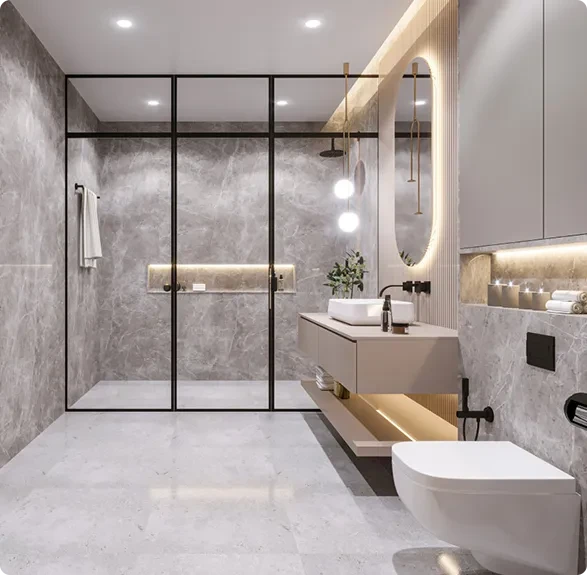
| Walls + floor | Tile JP8801 | Water absorption ≤ 0.5% (full porcelain), breaking strength ≥ 1300 N, abrasion resistance ≥ Grade 4 (PEI), slip resistance R10–R11 (DIN 51130) |
| Ceiling | Aluminium ceiling panel (fine white) | Thickness 0.6–0.8 mm (300×300 mm), flexural strength ≥ 200 MPa, coating salt spray test ≥ 500 h no rust |


New Zealand follows the same electrical safety standards as Australia. All electrical products exported to New Zealand must pass mandatory SAA certification (under the Electricity Safety Act 2004 and Electricity Safety Regulations 2006). Certification takes approx. 4–6 weeks. Under the mutual recognition agreement between Australia and New Zealand, products certified in Australia can smoothly enter the New Zealand market.
Electrical Component Standards
| Component | Applicable standard | Technical requirement |
|---|---|---|
| Plugs & socket outlets | AS/NZS 3112:2017+A1:2021 | 3-flat-pin type, rated 10A, 250V |
| Wall switches | AS/NZS 3133 | All-pole (double-pole) disconnection, meets shock protection |
| Distribution board | AS/NZS 3000 + AS/NZS 61439 | Main switch, RCD (≤30mA), compliant earthing |
| Industrial plugs/sockets | AS/NZS 3123 or AS/NZS 60309.1 | IP54 minimum, for industrial applications |
| Power cords | AS/NZS 3191 / 60227.5 / 60245.4 | 3-core ordinary or heavy duty, conductor ≥1.0 mm² |
| Extension leads | AS/NZS 3105:2014+A1:2017 | ≥3 outlets must have overcurrent protection |
-
Structure (B1)
After reinforcement by Fangda, the 40HQ container structure has a service life of 10–30 years. Yield strength: main beams ≥ 345 MPa, columns ≥ 235 MPa. Seismic design references NZS 1170 series – the flexible steel frame absorbs seismic energy better than rigid masonry.
-
Thermal insulation (H1)
Since 23 May 2023, insulation requirements for residential buildings ≤300 m² have been tightened. Recommended composite insulation: 50 mm rockwool/polyurethane (λ≤0.035 W/(m·K)) for walls, 100 mm for roof, achieving overall U-value ≤ 0.35 W/(m²·K).
-
Weathertightness & moisture (E2/E3)
All outdoor joints use weatherproof sealant + waterproof tape, overall waterproof rating IPX4 (splash-proof), toilet area IPX5 (jet-proof). Container chassis coated with epoxy zinc-rich primer (≥80 μm DFT) + epoxy micaceous iron oxide (≥120 μm) + polyurethane topcoat (≥60 μm), salt spray resistance ≥1000 hours.
-
Ventilation & moisture (E3)
Kitchen exhaust fan ≥150 m³/h, toilet exhaust fan ≥100 m³/h to control humidity and prevent condensation/mould.
Water Supply & Drainage
Water supply
External connection, indoor food-grade PPR pipes (PN20 rating), DN20, working pressure ≤1.0 MPa. Automatic leak-stop devices in kitchen and bathroom.
Drainage
Floor drains with water seal ≥50 mm, all drain pipes slope ≥2%. Wastewater discharge must meet local council requirements.
Electrical system
Fully pre-wired at factory; only on-site connection required.

FAQ
Q: Does your company is a factory or trade company?
A: We are factory, so you will enjoy the best price and competitive price.
Q: Can you offer designing service?
A: Yes, we have own design engineers. We could design full solution drawings as per your requirements.
Q: Do you accept container loading inspection?
A: You are welcomed to send an inspector, not only for the container loading, but any time during the production time.
Q: Do you have stock for all items?
A: In general, we produce based on the order which we confirmed.
Q: Are container homes safe?
A: Shipping containers are as safe and reliable as traditional homes. We all know that shipping containers can transport many different types of goods over long distances and need to go through many bumpy roads. This is a strict test for shipping containers and ensures that the goods can reach the customer unscathed. This also fully demonstrates the safety and reliability of shipping containers. They can withstand many tests such as weather and natural disasters, so container houses transformed from shipping containers are also safe and reliable.
Q: Are shipping containers hot to live in?
A: In fact, if no measures are taken, the container house will indeed be very hot when used in summer. We can consider making some modifications to the interior and exterior walls of the container, such as adding insulation materials, pasting wall panels on the exterior walls, and installing air conditioners inside to ensure that the container house can provide comfort under any temperature conditions. Living Space
40HQ expandable shipping container home NZ
SAA certified expandable house
NZBC compliant prefab expandable home
prefab expandable house for sale New Zealand
Hot Tags: 40hq expandable container house new zealand, manufacturers, customized, quotation, made in China, 20 foot expandable container room in action, 20HC expandable container house elevation, 20HC Expandable container house Rendering, 20HC expandable container house layout, Expandable container kiosk, Expandable container clothing store